

- New car market rises 7.2% in February with 90,100 vehicles registered.
- Battery electric vehicle (BEV) volumes up 2.8% as market share shrinks for second month.
- Year-to-date BEV share at 22.0% but must grow rapidly to reach mandated 33% this year.

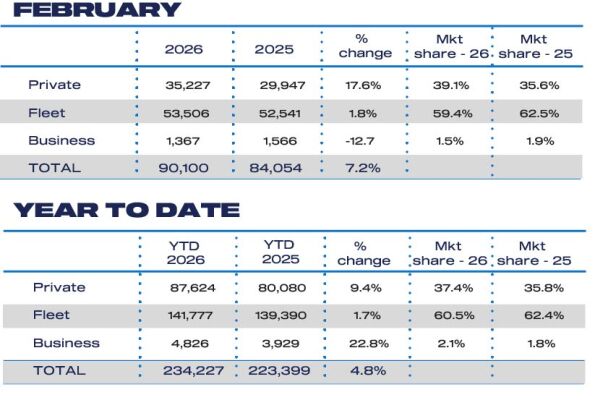
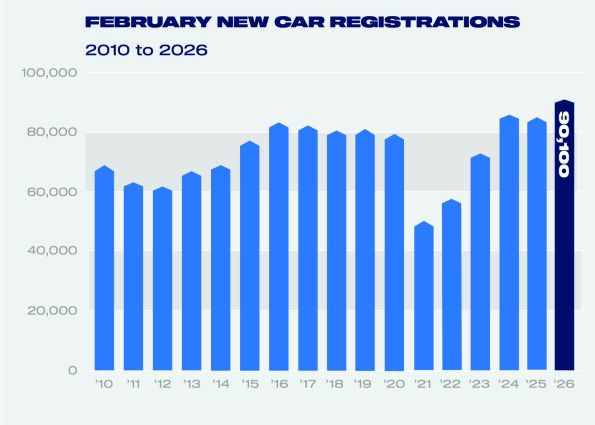
Thursday, 5 March 2026 The UK new car market rose by 7.2% in February to 90,100 registrations, according to the latest figures published by the Society of Motor Manufacturers and Traders (SMMT). The growth brings the highest February volume in 22 years,1 although the month is conventionally lower volume and therefore more volatile, with many buyers preferring to wait for the March numberplate change.
Demand was largely driven by recovering private retail registrations, up 17.6% to 35,227 units, while fleet uptake grew by 1.8% and the lower-volume business segment declined by -12.7%. Fleets remained the largest source of new car registrations, accounting for 59.4% of the market.
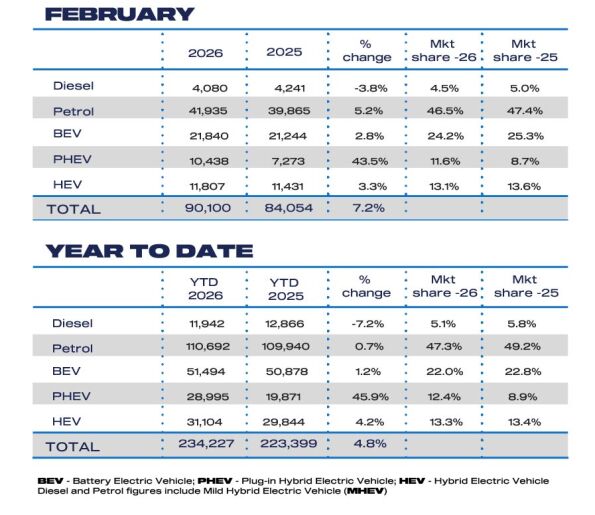
Battery electric vehicle (BEV) uptake rose 2.8% to 21,840 units, representing 24.2% of the market. February was, however, the second consecutive month of decline in BEV market share compared with the same period last year – a dip that partly reflects a strong start to 2025, when new BEV buyers sought to avoid April’s introduction of new tax rates, and comes after a strong push at the end last year to comply with the Zero Emission Vehicle Mandate.2 February’s lower overall volumes can also exaggerate change.
Meanwhile, plug-in hybrids attracted the largest growth in demand, up 43.5% to claim an 11.6% market share, while hybrid electric registrations rose 3.3% to a 13.1% share. Petrol demand also grew, by 5.2% but share slipped to 46.5%, while diesel volumes continued to decline, down -3.8% to just 4.5% of the market.
With year-to-date BEV market share at 22.0%, two thirds of the 33% share mandated for 2026, March is set to be a pivotal month. Manufacturers have already invested billions in new models and discounts to drive demand, now with support from government’s Electric Car Grant, but circumstances have changed beyond expectation since the regulation was set. A holistic review of the transition is needed – and must be completed urgently as buyer confidence is anticipated to be weakened further amid plans to introduce a pay per mile tax for EVs (eVED) from 2028.
Mike Hawes, SMMT Chief Executive, said, “The UK’s new car market is continuing to recover and EV volumes are growing too, even if market share remains disappointing. All eyes are now on ‘new plate’ March, which typically sets the tone for the year – and given sales of new pure petrol and diesel cars are currently required to end in less than four years, EV uptake must accelerate rapidly. Manufacturers have committed monumental investment to drive demand but such costs cannot be sustained indefinitely, making a review of the transition an urgent priority to ensure ambition matches natural demand.”
Notes to editors
1 February 2004: 91,460 registrations.
2 February 2025: 25.3%.
About SMMT and the UK automotive industry
The Society of Motor Manufacturers and Traders (SMMT) is one of the largest and most influential trade associations, representing the automotive industry in the UK.
The automotive industry is a vital part of the UK economy, integral to growth, the delivery of net zero and the UK as a global trade hub. It contributes £92 billion turnover and £25 billion value added to the UK economy and invested £5 billion in R&D, with 183,000 people employed directly in manufacturing and some 796,000 in total across the wider automotive industry. Many of these automotive manufacturing jobs are outside London and the South-East, with wages that are 8% higher than the UK average. The sector accounts for 13.4% of total UK exports of goods with more than 140 countries importing UK produced vehicles, generating £108 billion of trade in total automotive imports and exports.
The UK manufactures almost every type of vehicle, from cars, to vans, taxis, trucks, buses and coaches, as well as specialist and off-highway vehicles, supported by more than 2,500 component providers and some of the world’s most skilled engineers. In addition, the sector has vibrant aftermarket and remanufacturing industries. The automotive industry also supports jobs in other key sectors – including advertising, chemicals, finance, logistics and steel.
More detail on UK Automotive available in SMMT’s Motor Industry Facts publication at www.smmt.co.uk/reports/smmt-motor-industry-facts/
Words and charts are copyright of SMMT
5th March 2026
(Data for February 2026)