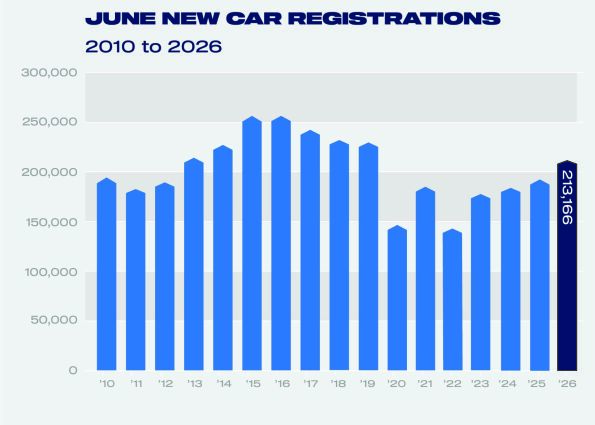
- June new car market rises 11.4% in best performance for the month since the pandemic.
- BEV uptake reaches 30.0% market share buoyed by growing choice, sustained discounting and quarter-end activity.
- Overall market 9.2% up at mid-year but BEV share remains below ambition, with three in four buyers still not switching.
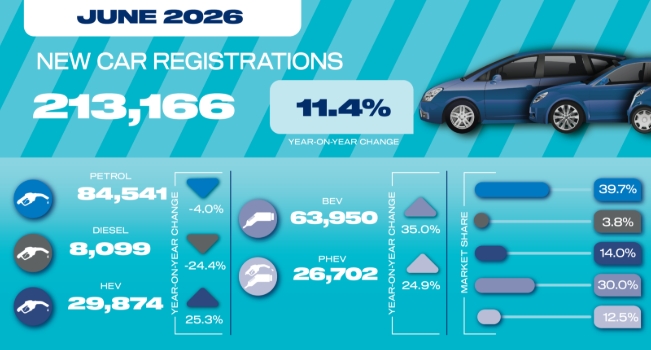
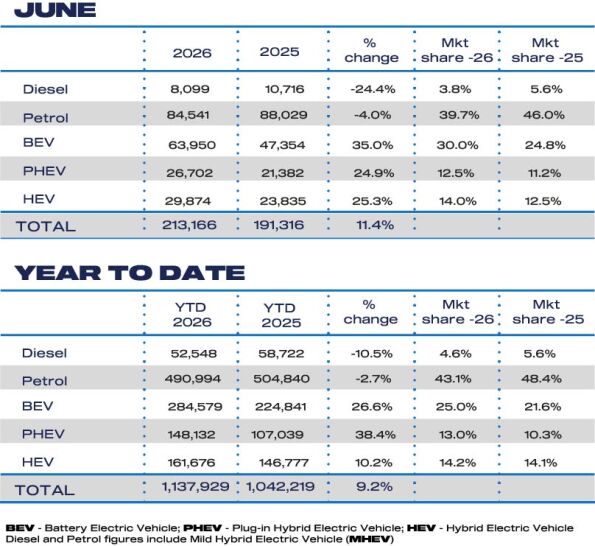
Monday 6 July, 2026 The UK new car market’s recovery continued in June, with registrations rising 11.4% to reach 213,166 units in the best performance for the month since 2019, according to the latest figures published today by the Society of Motor Manufacturers and Traders (SMMT).1
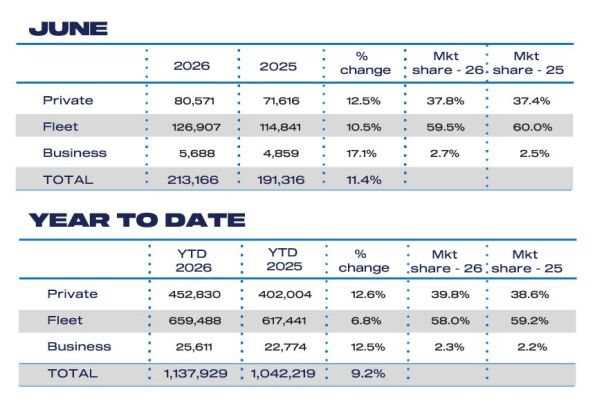
Growth was recorded across all sectors, with registrations by private buyers up 12.5%, fleet deliveries increasing by 10.5% and the smaller business segment posting a 17.1% rise. Fleets continued to comprise the lion’s share of the overall market, accounting for six in 10 (59.5%) new cars registered.
The uplift was driven entirely by electrified vehicles as the market continues to evolve, thanks to ongoing manufacturer investment in a wide choice of models and powertrains providing lower and zero emission mobility, as well as an expanded pool of brands now operating in the UK. Plug-in hybrids (PHEVs) took 12.5% of the market, while hybrids (HEVs) accounted for 14.0%. Battery electric vehicles (BEVs) saw the most significant growth to take a 30.0% share – the highest so far this year, reflecting the trend of high volumes at the end of each quarter and consumer interest spurred by the impact of the Middle East conflict on fuel prices.
Year to date, BEVs account for 25.0% of the market – a record achievement, but still far short of the 33% target. To meet it outright, BEVs would need to surpass 40% of new registrations across the rest of the year, yet three out of every four new car buyers are currently choosing other powertrains.2 Mandate flexibilities are helping manufacturers comply for now, but their value is diminishing as natural EV demand fails to grow at the pace expected. Despite more choice, government incentives and more than £12 billion in manufacturer discounts, uptake is still not rising fast enough – damaging profitability, diverting investment and weakening residual values.3
Automotive leaders are united in viewing the 2030 target as currently unachievable, with 100% of respondents to SMMT’s latest UK Automotive Business Leaders Barometer saying the UK is behind the trajectory needed to meet the mandated 80% share, and almost three quarters (73.8%) believing it is significantly behind.4
The industry remains committed to the transition, but urgent reform of the mandate is now essential. The unsustainable cost of compliance is making the UK an increasingly uncompetitive place to both sell and produce cars – putting investment at risk as other markets with less restrictive regulation become more attractive propositions.
Mike Hawes, SMMT Chief Executive, said, “June’s performance is very strong, showing EV uptake is growing, with battery electric cars reaching their highest market share this year and more than half of buyers choosing electrified models. But even these record levels are still not enough to meet mandated targets. Manufacturers are investing billions developing and bringing the vehicles to market – and spending billions more to sell them, yet the market is still not moving fast enough. Reforming the mandate now is essential not just to keep the transition on track but to protect the UK’s competitiveness, attract investment and safeguard jobs.”
Notes to editors
1 June 2019 registrations: 223,421 units.
2 Based on SMMT total market volume outlook for 2026 at April and BEV registration volumes Jan-Jun 2026.
3 Based on SMMT analysis of Autotrader data on EV discounts, SMMT estimated fleet discounts and EV car market data, and JATO sales weighted recommended retail price data – cumulative from FY 2024 to end of May 2026.
4 UK Automotive Business Leaders Barometer – SMMT member survey conducted 1 May-2 June 2026 with 50 senior automotive leaders. Respondents represent: £94bn turnover, 113,000 employees and 98.4% of UK vehicle production.
About SMMT and the UK automotive industry
The Society of Motor Manufacturers and Traders (SMMT) is one of the largest and most influential trade associations, representing the automotive industry in the UK.
The automotive industry is a vital part of the UK economy, integral to growth, the delivery of net zero and the UK’s position as a global trade hub. Manufacturing directly contributes £85 billion turnover and £18 billion value added to the UK economy, with £5 billion invested in R&D, with the wider automotive industry worth £400 billion. 188,000 people are employed directly in manufacturing and 830,000 in total across the wider automotive industry. Many of these automotive manufacturing jobs are outside London and the South-East, with wages 23.5% higher than the UK average. The sector accounts for 11.2% of UK manufactured goods exports (10% of total goods exports) and ships vehicles to more than 140 countries, generating approximately £111 billion in total automotive trade (imports and exports).
The UK manufactures almost every type of vehicle, from cars, to vans, taxis, trucks, buses and coaches, as well as specialist and off-highway vehicles, supported by more than 2,500 component providers and some of the world’s most skilled engineers. In addition, the sector has vibrant aftermarket and remanufacturing industries. The automotive industry also supports jobs in other key sectors, including advertising, chemicals, finance, logistics and steel.
Words and images are copyright of SMMT
6th July 2026